1917-1918
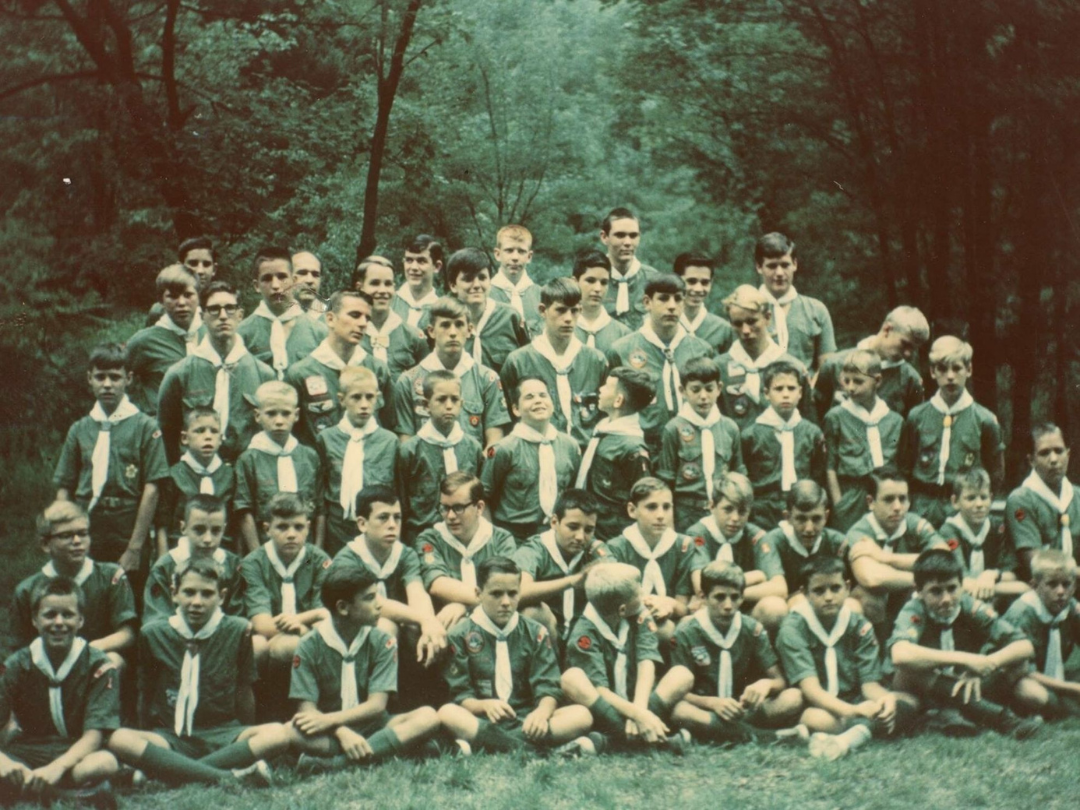
The Reverend N.B. Groton, Rector of St. Thomas Episcopal Church in Whitemarsh interested a group of citizens of Oreland in March of 1917 in the formation of a Boy Scout Troop.
Oreland Troop #1 was chartered in April of 1917 with Raymond H. Krecker as its Scoutmaster, meeting in the East Oreland School. The troop served the communities of Oreland, Fitzwatertown, and North Glenside. Sponsorship was continued by the “Group of Citizens” for 30 years.
The Troop immediately set the pattern of camping and hiking that has continued through its entire history. By the summer of 1918, the boys camped for the first time at Camp Delmont, built and maintained by the Delaware and Montgomery Counties Council of the Boy Scouts of America, (later known as The Valley Forge Council) and participated in many hikes in then rural area surrounding Oreland.
1919-1927
During this period of the troops’ history, leadership was given to our scouts by Edward H. Breisacher, fondly remembered by many of our former scouts as a dynamic and dedicated leader. The troop participated actively in the sale of Victory Bonds of World War I and great emphasis was placed upon the pioneering aspects of Scouting with the able assistance of Assistant Scoutmaster Leon Melair and later Jim Trindle. It was during this period, beginning with the year 1921 that Troop 1 established Oreland’s first swimming pool initially to afford a facility for swimming instruction for the scouts but which later became a recreational area for all the residents of Oreland as well as neighboring communities. During this time, there was scout camping near the pool area along the Sandy Run Creek which continued until the mid 1930’s. The Troop started regular weekend camping trips to Haycock Mountain in Bucks County. In 1924, Charles Zoll, the first Oreland Scout to reach Eagle rank, was awarded this high honor. In 1922, the Troop moved its meeting place to the West Oreland School where it met continuously for 25 years.
1928-1935
J.L. Trindle, Jr., who had served as Assistant Scoutmaster for several years, undertook the duties of Scoutmaster in 1928. His devotion to scouting and the Scouts of Oreland had greatly strengthened the Patrol Method of Operation and while periodic trips to Haycock Mountain continued, additional trips to Wellsboro, Hawk Mountain and other interesting camping spots were carried on. When the encroachment of new homes near the Sandy Run swimming pool necessitated the closing of Oreland Pool, the Troop established a new swimming area at Franklin’s Apple Orchard in Dresher. It was in the latter part of this period that Camp Arnold was established on the farm of the then Assistant Scoutmaster Arnold V. Eugerlaud, in Pughtown, Pennsylvania, which site was utilized for weekend camping until the mid 1940’s.
1936-1939
In the early part of 1936, Jim Trindle resigned to become Neighborhood Commissioner and Henry C. Jones Jr. was appointed Scoutmaster. In 1939, Harold G. Traver assumed the Scoutmastership for one year. During this period, the Troop continued to camp each summer at Delmont and used to good advantage the facilities at Camp Arnold.
1940-1945
A.D. Bothe became Scoutmaster in 1940. Under his leadership, great progress was made in the further development of the Patrol method and the Troop instituted a program of repairing and distributing toys at Christmas time which lasted for many years. Dave Bothe resigned in 1942 to move to Florida for health reasons and Hank Jones resumed Scoutmastership from 1942 – 1945. During this time, the troop participated in paper and metal collections in behalf of the war effort and successfully sold War Bonds in two different campaigns.
1946-1949
Gus B. Heller assumed the duties of Scoutmaster in 1946 when Hank Jones resigned to become District Commissioner of the George Washington District. In 1947, William J. Savory led the Troop for several months and the latter part of that year, Henry S. Cassel became Scoutmaster retaining that position until the end of 1949. In 1947, the Troop moved to the Christ Lutheran Church on Plymouth Avenue and they became sponsored by that institution for the first time and remained sponsored by them.
1950-1960
Hank Jones once again assumed the Scoutmastership in 1950 and remained there for many more years. After many years of financing the Troop through dues and occasional contributions, the Troop instituted a Christmas Tree sale that continued until the late 1960’s. In 1951, the Troop commenced their long pleasant camping experience at the National Farm in Swiftwater, Pennsylvania, as well as the Former Coast Guard Station at Stone Harbor New Jersey. This year also saw the beginning of the July 3rd evening camp fires which became a popular Scouting event for all scout troops in Oreland in connection with the Independence Day Celebration. the annual Troop Family Dinner on the Monday of Scout Week was begun in 1954 as was the Annual Scout Sunday Service both of which have been continued each year since. It was also in 1954 that the Troop Band was started under Ernie Thiele’s direction and lasted until the mid 1970’s.
1961-1967
In the fall of 1961, the Troop purchased a 18 acre tract of land at the foot of the Northern slope of Hawk Mountain in New Ringgold Pennsylvania to establish a permanent camp site for both long term Summer camping and weekend activities. It had long been felt by the troop leadership that greater opportunity for the development of Leaders would be afforded by the establishment of such a Camp and the results obtained have proven to be true.
In March of 1962, under the leadership of Troop Committee Chairman Albert Doering with the help of Al Delestatius, Bill English, Bob Foley, and many other Committeemen and interested fathers , the Scouts established five patrol camping areas with stone fireplaces and a 40′ x 16′ Dining Hall for both dining and rainy day activities, a well was dug and a water pump installed. these facilities enabled us to open our first Summer Camp in 1962.
From 1963 – 1968, four lean-tos were built near the Main Cabin for use by the staff, a Camp Chapel was developed on an island in the Indian Run for celebration of appropriate religious services, built a Ceremonial Campfire Area at the end of one field, developed one 150′ x 90′ pond for fishing purposes fed by the stream and underground fresh water wells. Another pond was established with the same dimensions for swimming purposes also.
1968-1985
Al Doering and Phil Marcolina built a stone and iron arch to Chapel Island in memorial to Lt. David M. Wilson. A fireplace was also installed in the Main Cabin. In July 1969, Summer Camp had guests, Don and David Lee-Thompson, scouts from Canada’s North Peel District along with over 20 Canadian Scouts. Participation in Great Adventure camping such as Philmont and Charles L. Sommers Canoe base were held during the Early parts of 1970.
By 1978, the Campfire site was moved and redesigned at the East end of Camp. The swim pond was dredged while also installing a new controllable drainage outlet. Two tree nurseries were established- 500 Norway Spruces in one area, and 500 European Larches on the site of the former Campfire site.
1979 saw the start of construction of the first of three bigger Lean-to’s for the patrols. The first cabin was named for Art Griffith, a former scout who died in Germany while serving in the Army. The second cabin built was dedicated to Al Doering, the last cabin was named for the “Founder of Hawk Mountain Camp”, Hank Jones. Each cabin required approximately 20 trips to camp and over 500 man hours to build.
During the next few years, a pioneer bridge spanning a section of the swamp near the upper pond to the Campfire site was built by Pioneering merit badge applicants. A nature trail was begun in memory of Assistant Scoutmaster Gus Irlenborn. The Delaware river Canoe trip as well as the Appalachian Trail hikes all became annual events in the troop’s activities.
1986-1997
Mike Weiss became Scoutmaster in 1986 and has been with the troop for over 50 years. During this period, Assistant Scoutmaster Fred Robinson, further exposed the troop to the outdoors drawing from his hunting experience. Every other year Survival trips are scheduled. In 1990, the troop enlisted the help of Warren Marley to help rebuild many of the structures that were falling apart at camp. Also Warren has brought the troop on rock climbing and repelling trips to Ralph Stover State Park as well as using a nearby cliff at our camp. Hank passed away in January 1992 and at our 75th Anniversary Dinner, the Troop dedicated the Dining Hall in Hank’s memory. Another one of the camp’s creators, Al Doering also passed away in 1995. Tore Vecchione also helped Warren in repairing many structures up at camp.
1998-2007
On August 25, 1998, Oreland Troop 1 posted its first web page. Since then, the site has changed servers and even Webmasters, but the virtual home for the troop has allowed its members to communicate more effectively.
Over these years, the troop’s adult leadership has grown tremendously. Since this time, over 20 active adult leaders joined the ranks of Oreland Troop 1 and have contributed to the troop in an outstanding manner. Since then, the amount of activities and community service projects have increased dramatically. Since 2001, Tore Vecchione has served as Troop Committee Chairman, taking over for Lou Miller. This increased adult presence has initiated numerous improvement projects to Hawk Mountain Camp. The troop has also seen the amount of young scout increase slightly. This rise in membership will keep the troop going for many years to come.
2008-
The troop remains strong with over 28 adult leaders and over 19 active scouts at the present time, organized into three patrols. The troop has CONTINUOUSLY served the community of Oreland for over 104 years! We received Gold awards several years in a row for outstanding leadership for the BSA’s Journey to Excellence (JTE) program. Three adults are certified as NRA Range Safety Officers, three adults certified NRA Youth Shooting Sport Instructors, and five adults certified as Archery level 1/2. The Troop serves the youths of Oreland, Wyndmoor, Fort Washington, Maple Glen and Flourtown Pennsylvania.